Should I buy this?
Scan packaged food and drinks sold in Canada. Get an honest score in seconds, and see what is worth knowing before it goes in your cart. Body wash, deodorant and other personal care get a score too.
 Built in Ontario for Canadian shoppers
- Honest
- Canadian
- Bilingual
- Never for sale
Try it
See a scan
Pick a product and tap Scan. Real NorthScan scoring on two sample products.
In the app, NorthScan reads every scan out loud, even through your earbuds.
Sample products. Scores use NorthScan’s real rules. Brand names left out.
- NorthScan’s own methodology
- Applied the same way to every product and every brand
- Based on nutrition, processing and reviewed additives
- The full calculation and sources are available for every score
- Canada's “High in” labels, checked for you.
- A plain-language score that tells you why.
- Better choices from products listed for Canada.
Swaps
A better choice, not just a bad score
When something scores low, NorthScan shows a better option from the same shelf, and tells you why.
How swaps are chosen ›
- Same kind of product, from the same shelf categories in Open Food Facts.
- Scores at least 5 points higher with NorthScan’s own rules.
- Has a complete score. A “Partial score” is never suggested, because missing data could make a product look better than it is.
- Has enough nutrition data to trust the comparison.
- Fits your settings: nothing you’re allergic to or avoid.
- Single-ingredient foods (honey, oats, maple syrup) get no swap: another brand is the same food.
“Prefer made in Canada” only changes the order of products that already score better. No brand can pay to appear as a better choice.
Built for Canada
Made for Canadian shelves
Health Canada rules
“High in” labels for sugars, sodium and saturated fat, checked for you.
Tap for details ›Health Canada rules
Since January 1, 2026, Health Canada requires a “High in” symbol on the front of packaged foods that are high in sugars, sodium or saturated fat. NorthScan checks each product against the same thresholds: generally 15% of the Daily Value in one serving (10% for small servings, 30% for main dishes).
A product that would carry the symbol can’t sit in the green. One flagged nutrient keeps the score at 59 or below, two at 49, three at 39. Foods Health Canada exempts, like plain milk, eggs and fresh fruit, aren’t capped.
Source: Health Canada, front-of-package nutrition labelling · The full rule
Tap to flip backRecall checks
Your scanned products checked against Government of Canada food recalls.
Tap for details ›Recall checks
When you open the app (at most every 6 hours), NorthScan compares recent Government of Canada food recalls, about the last 60 days, with the products you saved and the ones you scanned in the last 90 days. A match shows an alert on the product.
What it can miss: a recall can name a product in a way NorthScan doesn’t recognise, and many recalls cover only certain lot codes or best-before dates. No match is not a guarantee. Check the official list for anything you’re unsure about.
Source: Government of Canada recalls and safety alerts (Health Canada and the CFIA)
Tap to flip backEnglish and French
Labels in either language, translated when only one is printed.
Tap for details ›English and French
Canadian law requires most packaged food labels to be in both English and French. But product databases often hold the ingredient list in only one language, and some products, like certain imports or local foods, are allowed to use just one.
When that happens, NorthScan translates the ingredient list with its own food dictionary so you can read it in your language. Unusual words may stay as they are, and the package is always the final word. The whole app works in English and French.
Source: CFIA, bilingual food labelling
Tap to flip back“Product of Canada”
Shown when the package says so. Never guessed from an address.
Tap for details ›“Product of Canada”
The two claims mean different things under CFIA rules:
- Product of Canada: all or virtually all of the major ingredients, processing and labour are Canadian. Small amounts of imported spices, vitamins or flavourings (under about 2%) are allowed.
- Made in Canada: the last major step of making the food happened in Canada, and the label must add “from domestic and imported ingredients” or “from imported ingredients”.
NorthScan shows a badge only when the package or the product record says one of these. A Canadian company address doesn’t count, because the food itself may come from elsewhere.
Source: CFIA, “Product of Canada” and “Made in Canada” claims
Tap to flip back
Coming soon to NorthScan
Visit the NorthScan Diner
Meal ideas for your preferences, served like a menu. Pick a plate for the recipe and a shopping list, and see why it was suggested. These three are a preview.
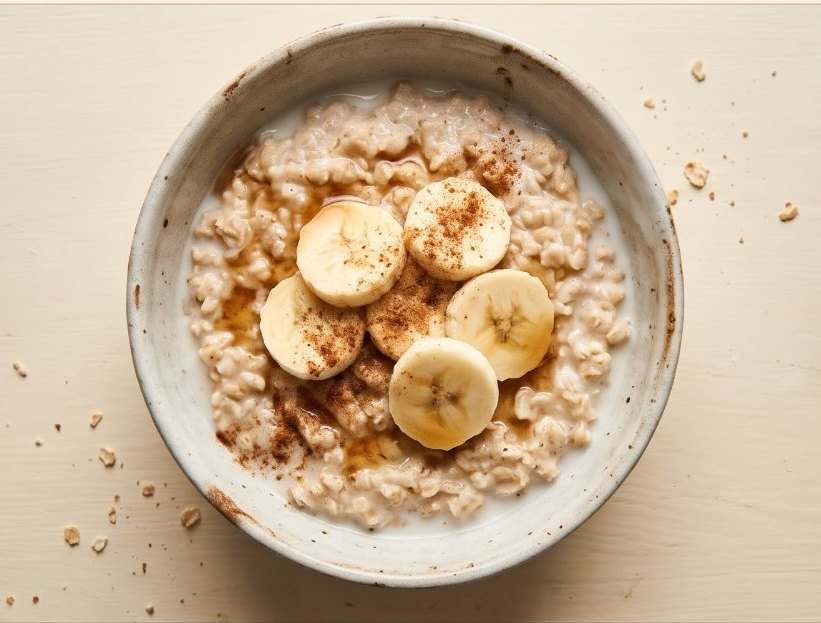
Breakfast
Creamy oatmeal with banana and maple
Recipe · Shopping list · Why this meal? ›Why this meal?
Creamy oatmeal with banana and maple
- Whole-grain oats for fibre, cooked in lower-fat 1% milk.
- Banana is a low-acid fruit, sweetened with a little maple syrup and cinnamon.
- No citrus, chocolate or mint. If coffee comes with your breakfast, it’s a common trigger to watch.
Recipe
Ingredients
- ½ cup (45 g) large-flake rolled oats
- 1 cup (250 mL) 1% milk
- ½ ripe banana, sliced
- 1 tsp pure maple syrup
- A pinch of ground cinnamon
- A pinch of salt (optional)
Steps
- Warm the milk in a small pot over medium heat until it just simmers.
- Stir in the oats and salt. Cook 5 to 6 minutes, stirring often, until creamy.
- Spoon into a bowl. Top with banana, drizzle with maple syrup and dust with cinnamon.
Shopping list
- Large-flake rolled oats
- 1% milk
- Bananas
- Pure maple syrup
- Ground cinnamon
Scan tip: Plain oats should list one ingredient: oats. Flavoured instant packets often add sugar and flavouring.
Based on published reflux guidance: Alberta Health Services, Managing Acid Reflux (acid reflux / GERD) · Stanford Medicine, LPR Protocol (LPR)
Tap to flip back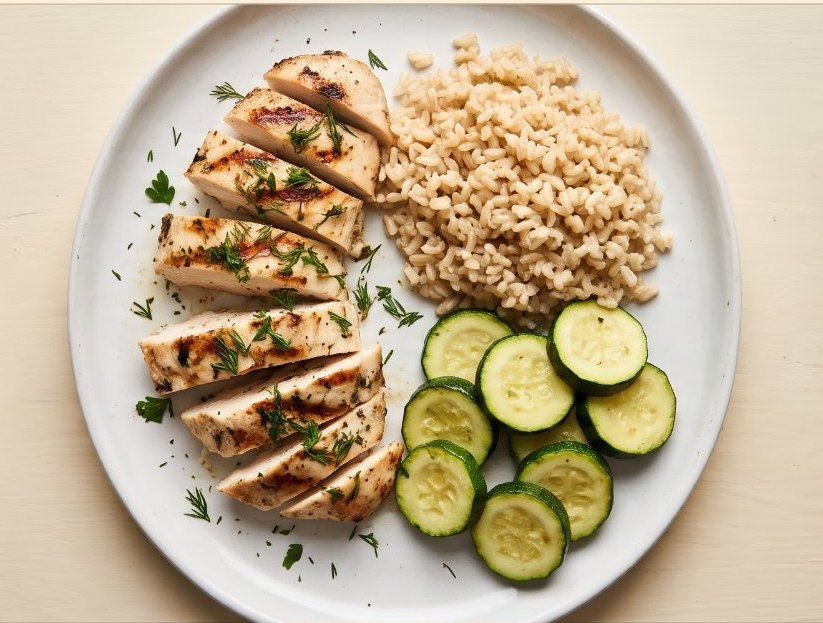
Lunch
Herb chicken, brown rice and steamed zucchini
Recipe · Shopping list · Why this meal? ›Why this meal?
Herb chicken, brown rice and steamed zucchini
- Lean skinless chicken breast, grilled rather than fried.
- Brown rice and zucchini for whole grains and vegetables.
- Flavoured with dill and parsley instead of garlic, onion or hot spices.
Recipe
Ingredients
- 2 small boneless, skinless chicken breasts (about 300 g)
- 1 tbsp olive oil, divided
- ¾ cup (150 g) quick-cooking brown rice
- 1 medium zucchini, cut in rounds
- 1 tbsp chopped fresh dill
- 1 tbsp chopped fresh parsley
- A pinch of salt
Steps
- Cook the rice as the package directs.
- Brush the chicken with half the oil and add a pinch of salt. Cook in a non-stick pan or on a grill over medium heat, 6 to 7 minutes a side, until the inside reaches 74°C (165°F).
- Steam the zucchini 4 to 5 minutes, until just tender.
- Slice the chicken and sprinkle with dill and parsley. Drizzle the rest of the oil over the zucchini.
Shopping list
- Boneless, skinless chicken breasts
- Quick-cooking brown rice
- Zucchini
- Fresh dill
- Fresh parsley
- Olive oil
Scan tip: Choose plain brown rice, not a seasoned mix: those often contain onion and garlic.
Based on published reflux guidance: Alberta Health Services, Managing Acid Reflux (acid reflux / GERD) · Stanford Medicine, LPR Protocol (LPR)
Tap to flip back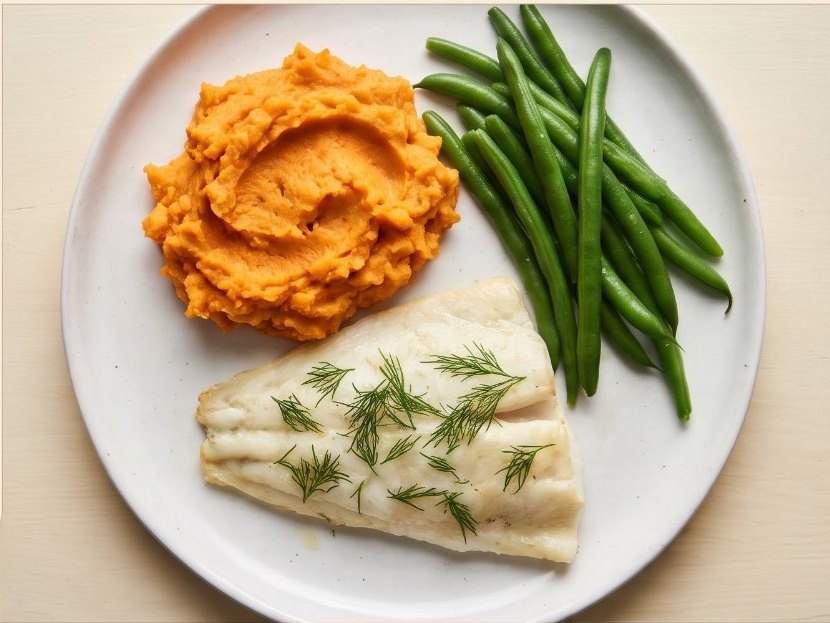
Dinner
Baked haddock, mashed sweet potato and green beans
Recipe · Shopping list · Why this meal? ›Why this meal?
Baked haddock, mashed sweet potato and green beans
- Lean white fish, baked, with no butter sauce.
- Sweet potato and green beans for fibre.
- Fresh dill instead of lemon: citrus is on the LPR list of foods to cut back.
Recipe
Ingredients
- 2 haddock fillets (about 300 g), thawed if frozen
- 2 tsp olive oil
- 2 medium sweet potatoes (about 500 g), peeled and cubed
- 2 tbsp 1% milk
- 200 g green beans, trimmed
- 1 tbsp chopped fresh dill
- A pinch of salt
Steps
- Heat the oven to 200°C (400°F). Boil the sweet potatoes about 15 minutes, until soft.
- Place the fish on a lined baking sheet, brush with the oil and add a pinch of salt. Bake 12 to 15 minutes, until it flakes easily and reaches 70°C (158°F).
- Steam the green beans 5 to 6 minutes.
- Drain the sweet potatoes and mash with the milk and a pinch of salt.
- Top the fish with fresh dill and serve.
Shopping list
- Haddock fillets (fresh or frozen)
- Sweet potatoes
- Green beans
- Fresh dill
- 1% milk
- Olive oil
Scan tip: Some frozen fish has added salt or phosphates. Scan it: NorthScan shows the sodium and lists any added phosphates.
Based on published reflux guidance: Alberta Health Services, Managing Acid Reflux (acid reflux / GERD) · Stanford Medicine, LPR Protocol (LPR)
Tap to flip backAI-generated illustrations. Your plate may look different. Meal ideas, not medical advice: triggers differ from person to person.
Can a brand pay for a better score?
No. Never. Brands can’t buy a score. Take the 10-second quiz to see how NorthScan is supported instead.
Our independence promise →Watchlist
New foods we’re keeping an eye on
Some of what’s coming to grocery shelves is new, and not everyone will want to guess. Here’s where each stands in Canada today.
Lab-grown meat
Meat grown from animal cells. Health Canada treats it as a novel food that needs a safety review before sale, and no cell-cultivated meat appears on its list of approved novel foods. Elsewhere it can be sold in the US, Singapore and Australia, while Italy and seven US states (Florida, Alabama and others) have banned it. See where it can be sold (Good Food Institute, checked November 2026).
3D-printed “meat” and seafood
Printed fillets and patties are sold in parts of Europe and the US. So far they’re plant-based, not made from animal cells. Read the ingredient list, and don’t assume the front says it.
Gene-edited crops
Under Health Canada’s 2022 guidance, many gene-edited plants don’t count as “novel” foods, so they can reach shelves without their own safety review. Health Canada keeps a public list of the ones developers have told it about. One example on the list is a gene-edited high-GABA tomato (listed March 2026, earliest entry to market 2026). The list doesn’t say where it is sold.
We’ll keep watching, and we’ll tell you when any of these reach Ontario shelves.
Checked November 2026. Sources: Health Canada, cellular agriculture; Health Canada, completed novel food safety assessments; Good Food Institute, where cultivated meat can be sold; cultivated-meat bans: Italy (Fortune), US states (Quartz); Health Canada, list of non-novel plant products; Health Canada’s 2022 guidance on gene-edited plants.
Get early access
Join the waitlist and be first to use NorthScan, before it opens to everyone. It takes about a minute.
You’re on the list!
Thanks — we’ll email you when early access opens. Questions? [email protected]